
Blueprint Chess · A practical guide
How to compare your move with an engine alternative
Put your move and the engine alternative side by side. Look at the replies each move allows and the position it leaves behind, then choose one difference to explore on the board.
Separate the verdict from the explanation.
A useful comparison starts with two moves and a question. In this Blueprint Chess review, White played 25.Bxf4, the review labels it a blunder, and the engine alternative is Bg4. Record those facts before trying to explain the difference.
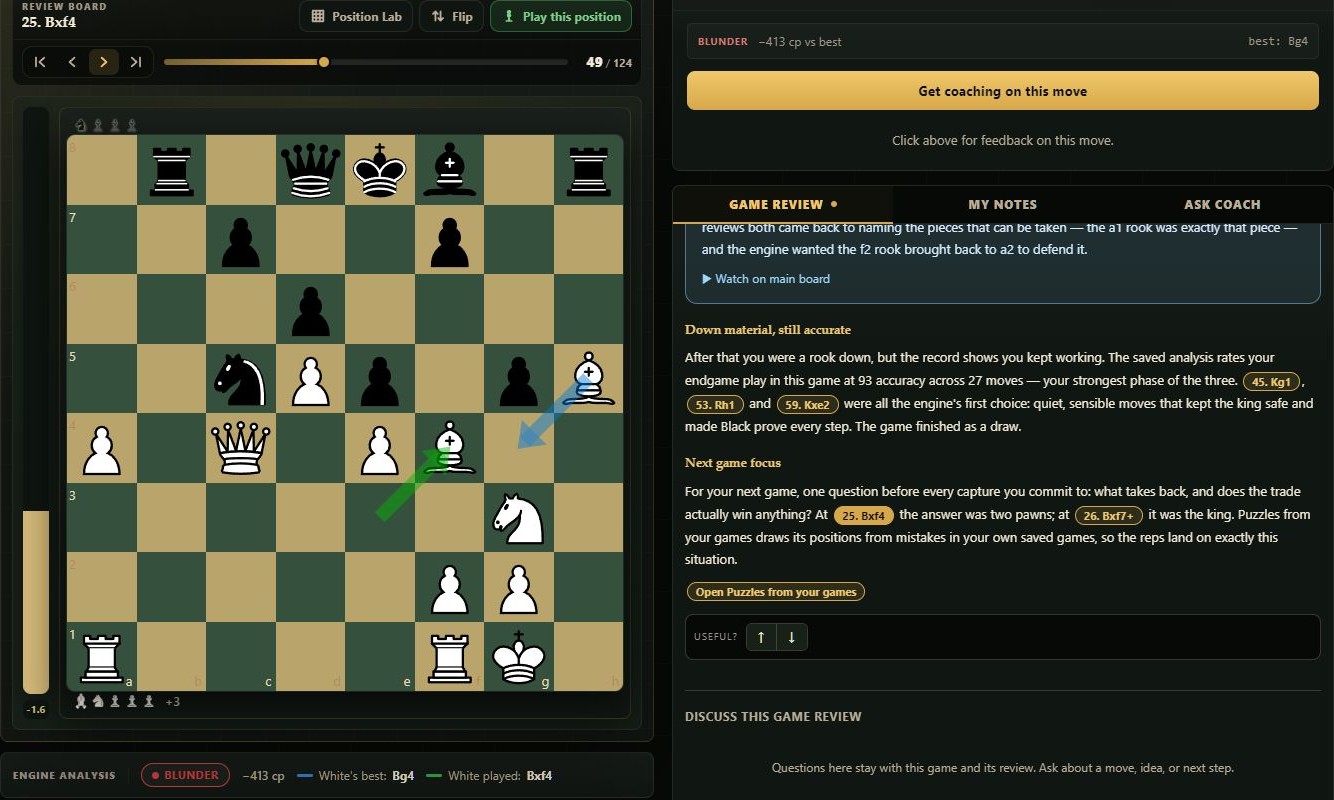
The board shows White’s bishop on f4 and black pawns on e5 and g5, both attacking f4. That gives you a concrete reply to investigate on each side of the bishop. Finding those replies starts the calculation; you still need to follow the exchange and check the resulting position.
Keep your own reasoning separate from the review’s label. If you no longer remember why you chose the capture, write “original idea unknown” instead of inventing an explanation after seeing the answer.
Write a comparison you can check.
Here is how a comparison note could look for this position.
- Move played
- 25.Bxf4.
- Alternative to examine
- Bg4, identified as the engine preference in the saved review.
- Review
- The review calls Bxf4 a blunder.
- Visible board evidence
- The bishop on f4 is attacked by the pawns on e5 and g5. Examine …exf4 and …gxf4.
- Calculation still to do
- Follow the replies after each recapture. Check the material and position at the end of the sequence.
- Question about the alternative
- Return to the position before White’s move and work out what Bg4 changes. The image shows the position after Bxf4.
This note avoids treating “the engine preferred it” as your whole explanation. You can now point to the board evidence you understand and the analysis you still need.
Leave the review with one answerable question.
For this position, start with: “What happens after each pawn recaptures on f4?” Then compare that result with the alternative from the position before the capture. Use a board or your usual analysis tool so you can check replies for both sides.
A move-comparison note to copy
Position before my move: ___
Move played and original idea: ___
Engine alternative: ___
What the review says: ___
Reply I checked on the board: ___
What I still need to calculate: ___
Use this note with a board or your usual analysis tool. The earlier review guide shows how to carry the question into your next game; the Blueprint walkthrough shows how a game review leads to a personal puzzle.
From the foundry
See what’s taking shape.
Blueprint Chess: Invite-only beta. The previews show work in progress. Joining the waitlist registers your interest. Testing invitations will follow when opportunities are available.
Explore the product and testing details