
Forecheck · A practical guide
Why your fantasy hockey league’s scoring changes player value
A player’s value depends on what your league rewards. In a points league, the same stat line can rank differently when scoring weights change. In a categories league, the categories you need matter more than a single points total.
Check the settings before comparing players.
A general ranking is only a starting point. Before using one to make a roster decision, identify your league’s scoring format, counted statistics, position rules, and relevant time period. Two managers can reasonably value the same player differently because they are trying to solve different problems.
In a points league, multiply each counted statistic by its assigned weight and add the results. In a categories league, compare the categories individually; adding invented weights creates a different scoring system. Yahoo’s scoring and stat guidance explains where to find your league’s settings. Use those settings as the source of truth.
For a points comparison, it helps to write the calculation down. The small example below holds goals and assists constant and changes only the value of a shot. Nothing about either skater’s performance changes.
See how one weight changes the order.
Same skaters. Different scoring.
| Skater | Goals | Assists | Shots | Points |
|---|---|---|---|---|
| Skater A | 1 | 1 | 2 | |
| Skater B | 0 | 2 | 10 |
Try 0.3. Use the arrow keys to adjust. Your choices stay on this page.
At 0.1 points per shot, Skater A leads: 5.2 points to 5.0.
At 0.1 points per shot, A’s goal keeps A narrowly ahead. At 0.3, B’s larger shot total is worth enough to put B first. That reversal is the reason to ask what a ranking actually measures before treating its order as advice.
This is a teaching example with fictional skaters, not current NHL statistics, a projection, or a Forecheck recommendation. Real leagues may count additional skater and goalie statistics, bonuses, or penalties. Apply every relevant rule when comparing actual players.
Put the ranking in context.
The Forecheck development preview below shows player rankings from a saved league snapshot. Its ranking context describes relative performance within the collected player pool. That is different from predicting what a player will do next.
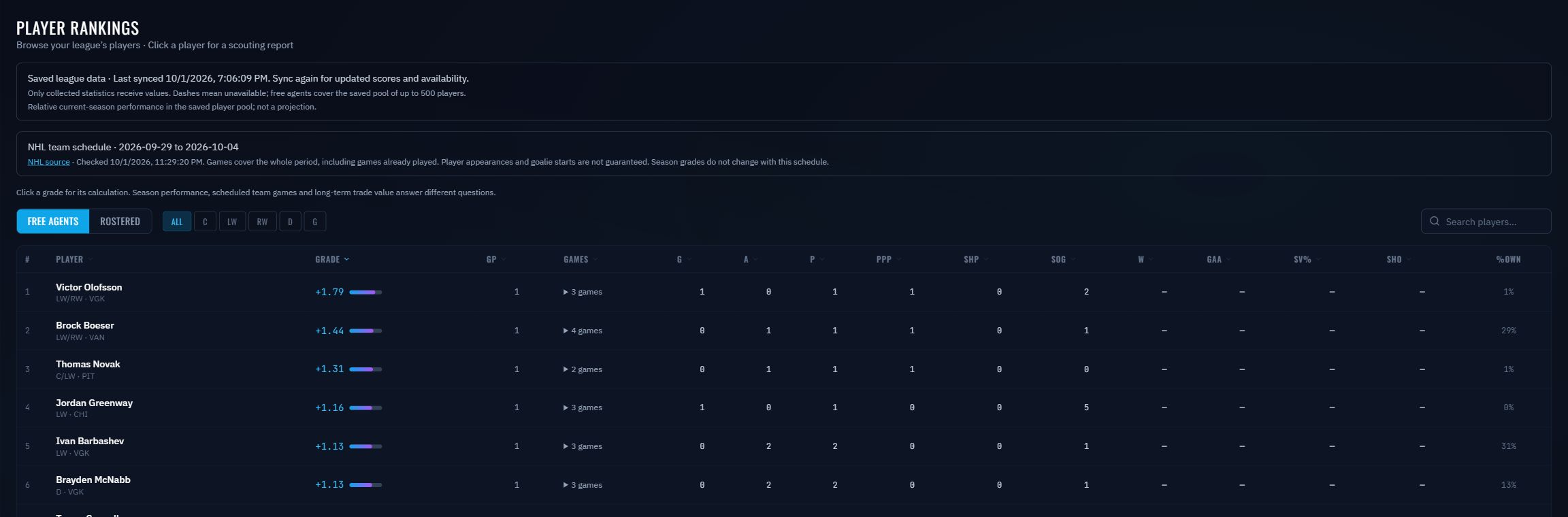
- Check freshness and sample size. A short stretch of games gives less context than a longer period. A dated capture cannot establish today’s best move.
- Check coverage. A ranking within a collected pool is not necessarily a ranking of every eligible player. A missing statistic is unknown, not automatically zero.
- Check your roster constraints. A player can score well and still be a poor fit for an occupied position, an unusable lineup slot, or your current matchup needs.
- Separate description from forecast. Ask whether the ranking summarizes recorded performance or estimates future output. Those answer different questions.
A useful question for any ranking: “Which league rules, data window, and player pool produced this order—and what decision does it help me make?”
What is Forecheck being built to do?
Forecheck is being developed around your fantasy hockey league, with league context informing rankings and a personal newsletter. The site currently shows a rankings preview. It does not show a finished newsletter or promise live recommendations to everyone who joins the waitlist.
From the foundry
See what’s taking shape.
Forecheck is in development; the previews show work in progress. Joining the waitlist registers your interest. Testing invitations will follow when opportunities are available.
Explore the product and testing details