Blueprint Chess · A practical guide
How to turn a chess game review into useful practice
Choose one decision from your game, work out why it failed, then practice the question you should have asked before moving. A review becomes useful when it changes what you look for in the next game.
Start with one decision, not a whole game’s worth of mistakes.
An engine can identify the move where a position deteriorated. The useful follow-up is more specific: what did you believe when you chose that move, and what did you overlook? Pick a position you remember finding tempting or confusing. Before reading the explanation, write down your original idea.
In this saved Blueprint Chess review, White played 25.Bxf4. The review flags the capture as a blunder and shows Bg4 as the engine’s preferred move. The coaching focus is a question you can reuse: after a capture, what can take back, and does the exchange actually help?
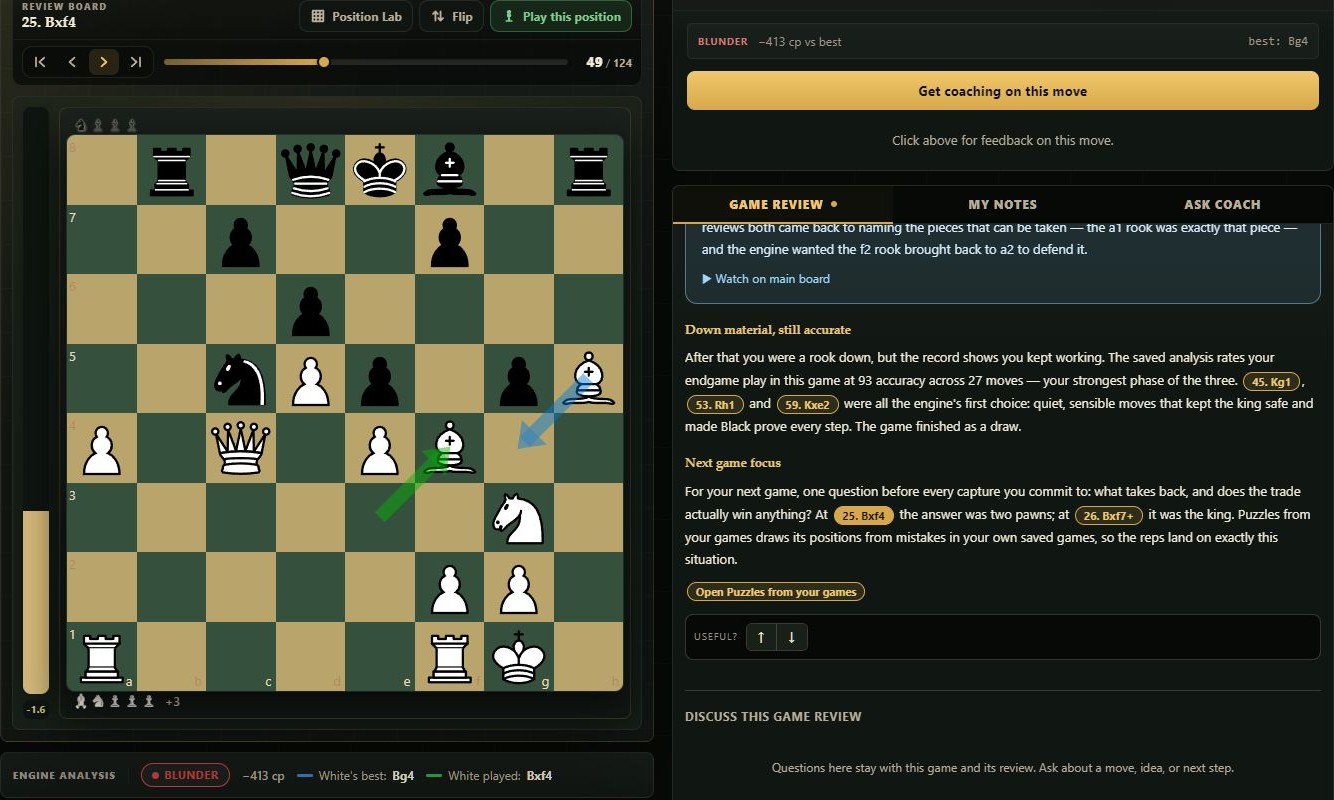
On the board shown, the black pawns on e5 and g5 both attack f4. Noticing those replies is the first check. It does not, by itself, explain every consequence of the position or prove which reply is best; that is where calculation and the full review come in.
Turn the explanation into a small exercise.
The following exercise is a companion to the screenshot. You can use the same process with a position from your own game, on a board or in your usual analysis tool.
- Pause before the tempting move. Name what the capture appears to win. Avoid starting with the engine’s label; reconstruct the decision you actually made.
- List the opponent’s replies. Identify every legal recapture, then look for forcing moves such as checks or threats that could change the exchange.
- Follow the exchange through. Compare the material and resulting position after the sequence. Do not stop your calculation at the first piece you take.
- Compare an alternative. In this review, examine Bg4 alongside Bxf4. Try to describe the difference in ordinary language before checking the full analysis.
- Write one prompt for next time. For example: “Before a capture, list what can take back and evaluate the position after the trade.”
A specific prompt gives you something to rehearse. “Stop blundering” does not tell you what to do when you are looking at the next position.
Check the habit in your next game.
Use the prompt when a similar decision appears. Afterward, review whether you checked the replies and followed the exchange far enough. A good outcome is being able to explain your choice, even if you still need help evaluating the final position.
A review note you can copy:
Position or move: ___
What I expected: ___
Reply I missed: ___
Question to ask next time: ___
Do I need Blueprint Chess to use this method?
No. The exercise works with a board and a game you can review. Blueprint Chess is being built to connect your games, coaching explanations, and practice. The preview includes a route to puzzles from your games, but it is a development preview, and this article is not a promise of immediate app access or a particular improvement in rating.
From the foundry
See what’s taking shape.
Blueprint Chess is in development; the previews show work in progress. Joining the waitlist registers your interest. Testing invitations will follow when opportunities are available.
Explore the product and testing details